PI-VAV vs Bypass VAV: Which Fits Your System?
A pressure independent VAV box holds a set airflow to its zone while duct pressure changes, and suits variable-volume supply systems. A bypass VAV box suits a constant-volume source: it diverts the air the zone does not need to the ceiling plenum or return. Choose by the supply system first, then size by zone airflow.
What a VAV box does
A VAV (variable air volume) terminal controls how much conditioned air reaches a zone. A damper in the box responds to a signal from the zone thermostat. MEPTECH's VAV boxes are fitted with an actuator that accepts 0-10 V or 2-10 V signals from thermostats.
The two common arrangements differ in what happens to the air the zone does not need.
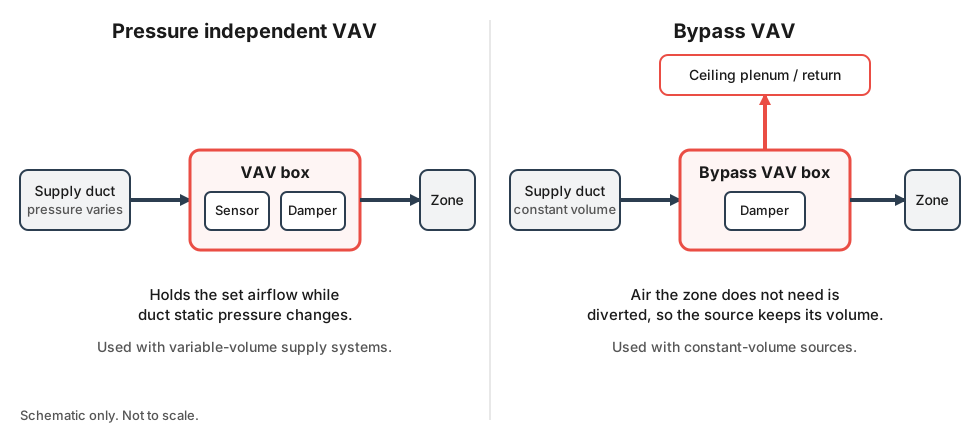
Pressure independent VAV (PI-VAV)
A pressure independent box measures airflow and holds the set value even when the pressure in the duct changes, so each zone receives the airflow it needs. MEPTECH's MT-PIVAV boxes respond to a duct static pressure or zone temperature control signal.
- Airflow sensor: a cross-flow sensor with multiple averaging points, positioned as MEPTECH states per ISO 10780, measures the whole cross-section of the inlet.
- Control: proportional between 20 and 100% of the volume flow range, depending on the controller used.
- Range: 10 sizes with nominal airflow from 374 to 6,524 m³/h.
Bypass VAV
A bypass VAV system connects the boxes to the supply duct of a constant-volume source. The primary damper modulates with the zone thermostat. When the blade is fully or partly closed, the unwanted air is diverted into the ceiling plenum or a ducted return through the bypass opening.
- Source: MEPTECH describes it as a simple way to distribute and control airflow from constant-speed FCUs, AHUs or packaged units.
- Damper travel: from full shut-off to full open, and a minimum opening can be set mechanically on the actuator.
- Range: 11 models, A to K, from 30 to 80 l/s up to 1,300 to 1,700 l/s.
PI-VAV and bypass VAV compared
| Pressure independent VAV | Bypass VAV | |
|---|---|---|
| Typical supply source | Variable-volume system where duct static pressure changes | Constant-volume source: constant-speed FCU, AHU or packaged unit |
| Unwanted air | The box reduces the airflow to the zone; the system responds at the supply fan and duct | Diverted to the ceiling plenum or ducted return |
| Source fan at part load | Can reduce airflow as boxes close (depends on the system design) | Keeps supplying its constant volume |
| Airflow sensing | Cross-flow sensor with multi-point averaging | Damper modulation with the zone thermostat; no airflow sensor is stated on MEPTECH's data |
| Control range stated by MEPTECH | 20 to 100% of the volume flow range, depending on the controller | 0 to 100%, depending on the controller; minimum opening can be set on the actuator |
| Sizes | 10 sizes, nominal 374 to 6,524 m³/h | 11 models, 30 to 1,700 l/s |
| Construction | 22 ga galvanised casing; double-skin 24 ga blade with gasket | 20 ga galvanised casing and blade with gasket |
| Insulation | 13 mm, 32 kg/m³ acoustic lining | 13 mm, 32 kg/m³ acoustic lining |
The "source fan at part load" row is a general HVAC principle, not a MEPTECH specification. All other figures are from MEPTECH's published MT-PIVAV and MT-BPVAV data.
How to choose
- Identify the supply source. A variable-volume system with duct static pressure control points to PI-VAV. A constant-speed FCU, AHU or packaged unit points to bypass VAV.
- Get each zone's minimum and maximum airflow from the consultant's design.
- Pick the size whose airflow range covers the zone, using the manufacturer's table on the product page.
- Decide the controls: thermostat signal (0-10 V or 2-10 V) or direct digital controllers.
- Plan acoustics. For PI-VAV, MEPTECH offers an extended terminal box for extra attenuation and secondary attenuators.
- Decide whether reheat is needed. MEPTECH lists electric duct heaters as an option for PI-VAV.
From our projects
A completed project related to this topic.
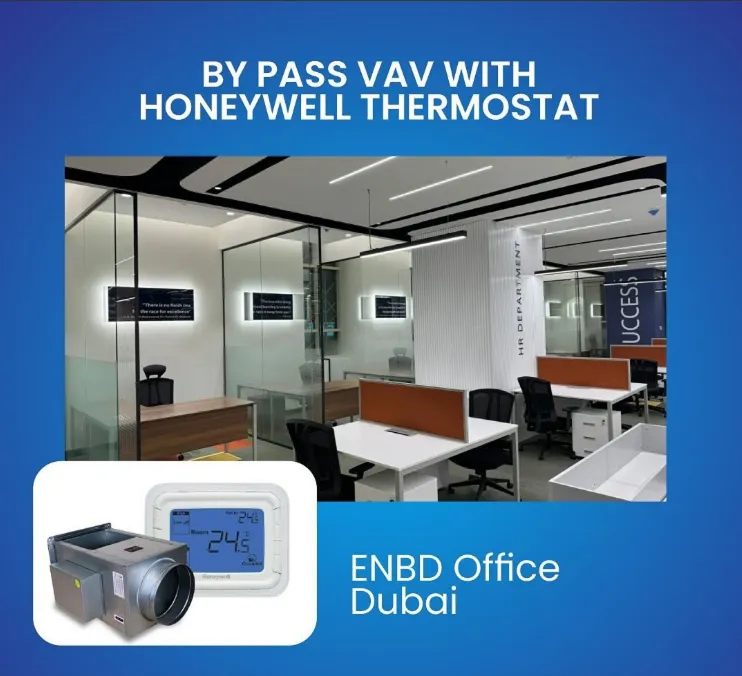
Advanced Bypass VAV systems Integrated with Honeywell thermostats
Thrilled to announce! Successfully completed a prestigious project involving the Supply & commissioning of Bypass VAV systems with Honeywell thermostats. With a proven…
Read the case studyFrequently asked questions
The box holds the set airflow even if the duct static pressure changes, so the zone airflow does not depend on the pressure upstream.
Related products
Sources
Technical claims on this page are attributed to the documents below. Figures quoted from manufacturers are the manufacturer's own, under its own test conditions. This page contains no prices or performance guarantees.
- MEPTECH: MT-PIVAV pressure independent VAV, product data Size range, construction, sensor, control range and options
- MEPTECH: MT-BPVAV bypass VAV, product data Operating principle, sizes and construction
- ISO 10780 Cited by MEPTECH for airflow-sensor positioning. The standard itself is not reproduced here.
- ASHRAE Handbook, HVAC Systems and Equipment Recommended reading on VAV system design. Not quoted here; the principles stated are general.
Working on a project?
Share your drawings or requirements and our technical team will review them and send a quotation.