VRV vs VRF: What Is the Difference?
VRV and VRF describe the same kind of system: one outdoor unit serving several indoor units through refrigerant piping, with the refrigerant delivered varying with the load. VRF is the generic industry term; VRV is the name Daikin uses for its own range. The useful question is how a specific system is rated and what it can do at your site.
The short answer
VRV and VRF describe the same kind of system: an inverter-driven air conditioner in which one outdoor unit serves several indoor units through refrigerant piping, and the amount of refrigerant delivered changes with the load.
VRF stands for variable refrigerant flow and is the generic industry term. VRV stands for variable refrigerant volume and is the name Daikin uses for its own range. Daikin first launched VRV in Japan in 1982.
So the useful question is rarely "VRV or VRF?". It is how a particular system is rated, what it can do at your site, and what it needs from the building.
How a variable refrigerant system works
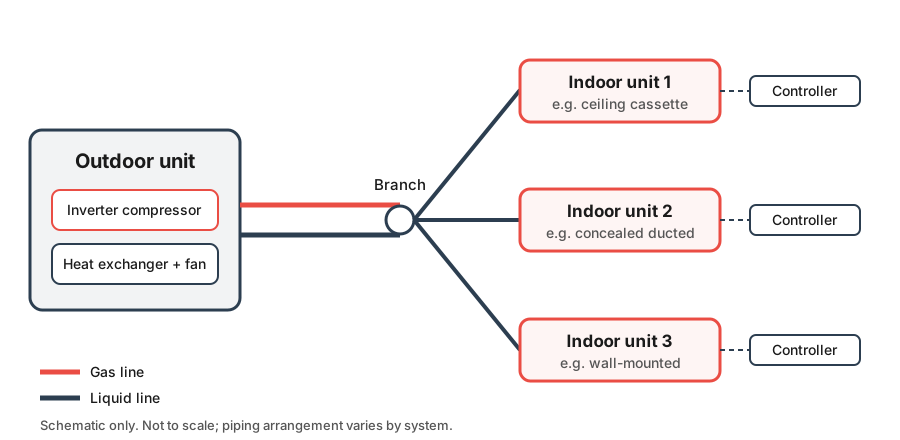
An outdoor unit contains one or more inverter-driven compressors and a heat exchanger. Refrigerant piping runs from it to a branch and on to the indoor units. Each indoor unit has its own controller and regulates how much refrigerant it receives, typically through an electronic expansion valve.
Because the compressor speed changes with demand, the system does not simply switch on and off. When only a few rooms need cooling it delivers less refrigerant; when most do, it delivers more.
What Daikin adds: variable refrigerant temperature
Daikin states that in a standard VRF system, capacity is controlled only by varying the speed of the inverter compressor. Its variable refrigerant temperature (VRT) control also varies the evaporating temperature of the refrigerant, so the system can run at a higher refrigerant temperature when the load is low.
Daikin's VRV X catalogue claims seasonal efficiency up to 28% higher than conventional VRF. Daikin's VRV IV+ page quotes up to 28% higher seasonal efficiency and an evaporating temperature range of 3 °C to 16 °C.
These are manufacturer figures from Daikin's own test conditions. Ask for the rating data for your project rather than relying on a headline percentage.
How to compare VRF proposals fairly
Whichever brand is proposed, compare the same things. The table shows what to ask for and gives examples of what Daikin publishes.
| What to compare | Why it matters | Example from Daikin's documents |
|---|---|---|
| Seasonal efficiency at hot-climate conditions | A nominal EER is measured at one outdoor temperature. A seasonal figure reflects part-load operation across a hot-climate season. | Daikin quotes CSPF T3, calculated under ISO 16358-1 Amendment 1 (2019). Its example for a 12 HP VRV X unit (RXQ12ARYFK) gives a T3 EER of 8.89 Btu/h per W. |
| Outdoor operating range | The unit must keep delivering capacity at your peak ambient temperature. | VRV X is offered in a High Ambient version. The VRV Apt catalogue states cooling operation up to 54 °C outdoor temperature. |
| Outdoor unit size | Sets how large a single system can be. | VRV X outdoor units are listed up to 48 HP in 2 HP steps. |
| Indoor unit limits | Each system limits how many indoor units it can serve. | VRV Apt: up to 6, 8 or 9 indoor units on 4, 5 or 6 HP. |
| Piping limits | Total length and level difference decide whether the layout is possible. | VRV Apt: total piping up to 300 m, actual piping up to 120 m, and up to 50 m level difference with the outdoor unit above the indoor units. |
| Indoor units and controls | Affect finishes, ceiling voids and connection to building management. | Check the indoor unit lineup and controller options for the exact series. |
| Efficiency regulation | Equipment may need to meet minimum efficiency requirements. | Daikin's VRV Apt catalogue states that ESMA has adopted the seasonal-efficiency standard and enforces minimum energy performance standards on VRF manufacturers in the UAE. Confirm the current requirement with the authority before specifying. |
Sources: Daikin Middle East VRV X, VRV IV+ and VRV Apt documents listed below. Values are for the specific series named and are not general limits.
Daikin VRV lines we supply in the UAE
MEPTECH supplies three Daikin VRV lines. Each has its own page with images and features.
| Line | Type | Notes from Daikin |
|---|---|---|
| VRV IV+ | Heat pump | Versions with and without continuous heating; VRT; four-sided heat exchanger. |
| VRV X | Cooling only | High Ambient version; outdoor units up to 48 HP; VRT. |
| VRV Apt | Mini VRV for apartments and small premises | 4, 5 and 6 HP outdoor units; low-height single-fan design. |
From our projects
A completed project related to this topic.
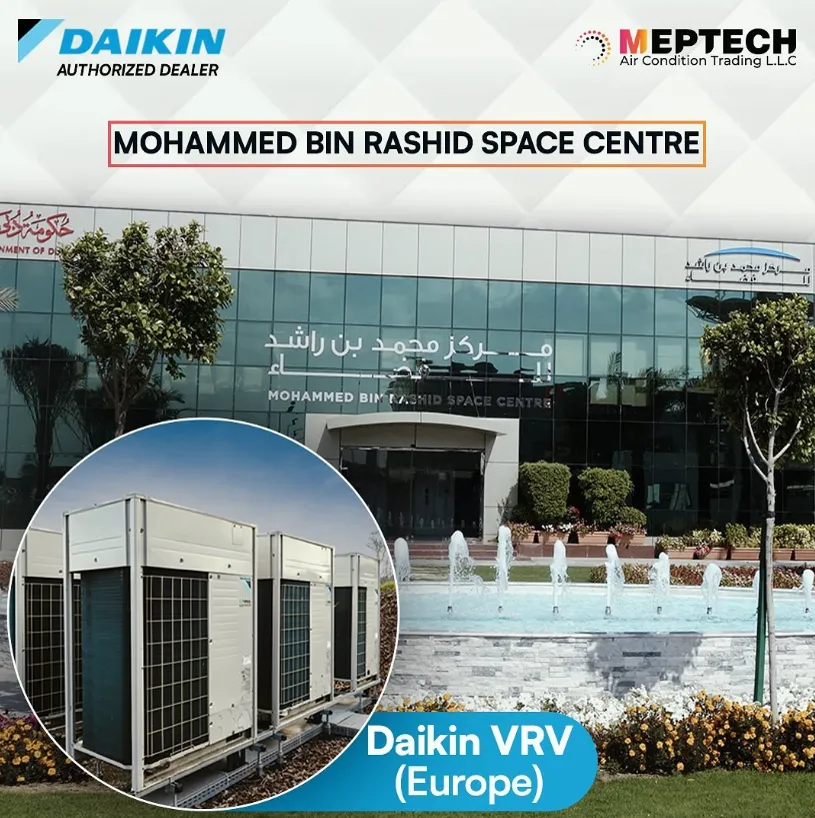
Daikin(Europe) VRV Systems - Mohammed Bin Rashid Space Centre
Successfully delivered Daikin (Europe) VRV systems, ensuring a state-of-the-art climate control solution for this cutting-edge facility. By choosing Daikin’s VRV units,…
Read the case study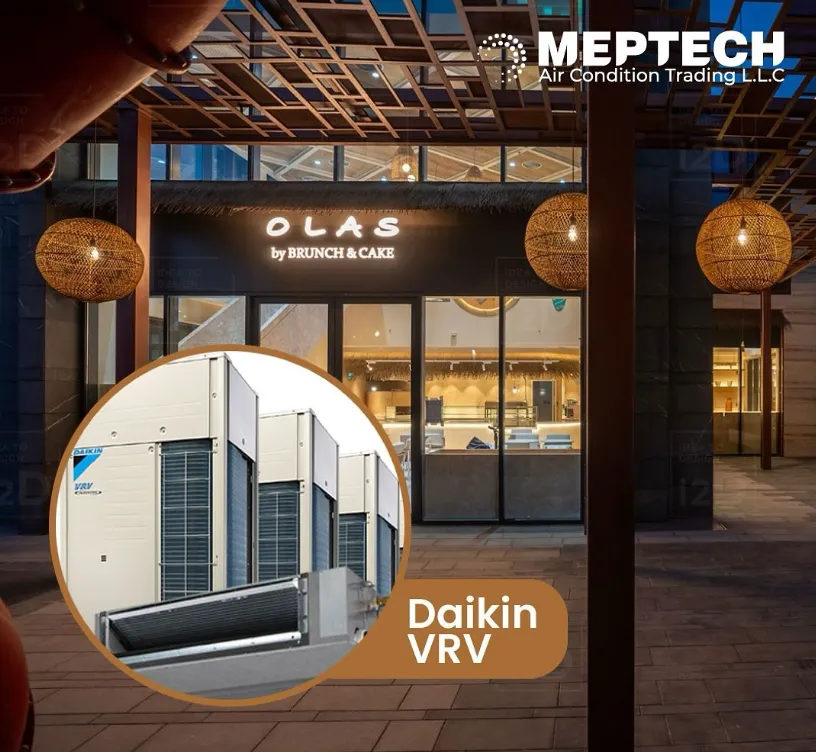
Successful installation of a state-of-the-art VRV system - OLAS by Brunch and Cake!
Successfully completed the installation of an advanced VRV system at OLAS by Brunch & Cake, engineered to provide efficient cooling, consistent indoor comfort, and…
Read the case studyFrequently asked questions
VRV is Daikin's brand of VRF. Whether it is the better choice for a project depends on the rated performance at your conditions, the system limits and the support available. Compare rating data, not the name.
Related products
Related articles
Sources
Technical claims on this page are attributed to the documents below. Figures quoted from manufacturers are the manufacturer's own, under its own test conditions. This page contains no prices or performance guarantees.
- Daikin Middle East: Cooling Only | High Ambient VRV X catalogue (RXQ-ARYFK) VRT, outdoor unit lineup, seasonal efficiency, CSPF T3 explanation
- Daikin Middle East: VRV IV+ heat pump product page VRT, evaporating temperature range, continuous heating
- Daikin Middle East: VRV Apt catalogue Indoor-unit and piping limits, operating range, ESMA statement
- ISO 16358-1 (cooling seasonal performance factor), Amendment 1 (2019) Cited in Daikin's catalogues for the hot-climate CSPF T3 method. The standard itself is not reproduced here.
Working on a project?
Share your drawings or requirements and our technical team will review them and send a quotation.